
Fakhar's century, the Minhas-Nawaz stand of 94 and Shaheen's finish: Pakistan chase down 326 with three wickets to spare
पाकिस्तान ने श्रीलंका के 325/8 के जवाब में 326 रन का लक्ष्य सात विकेट खोकर हासिल किया और मैच तीन विकेट शेष रहते जीता। पाकिस्तान की पारी 14/2 पर लड़खड़ाई थी — बाबर आज़म बिना खाता खोले आउट हुए। फखर ज़मान ने 127 रन बनाए, लेकिन उन्हें 6, 69 और 106 रन पर तीन बार जीवनदान मिला। साद बेग ने अपने बीसवें जन्मदिन से पहले 74 रन की पारी खेली। मिन्हास और मोहम्मद नवाज़ ने 94 रन की साझेदारी की, पर जीत के लिए दो रन चाहिए थे तब मिन्हास और फहीम लगातार आउट हुए; आखिर में शाहीन आफरीदी ने बाउंड्री के पार शॉट लगाकर मैच खत्म किया। शाहीन ने कामिंदु मेंडिस और दासुन शनाका के विकेट भी लिए, जबकि हारिस रऊफ़ ने आखिरी ओवरों में दो विकेट निकाले। श्रीलंका ने 41 ओवर में 255/2 से आगे बढ़कर आखिरी नौ ओवरों में छह विकेट गंवाए और 325/8 पर सिमटी। कामिंदु मेंडिस ने 131 रन बनाए — उनका करियर का सर्वोच्च स्कोर, जो पिछले सर्वश्रेष्ठ से दोगुने से अधिक था — और पवन रथनायके ने 77 रन जोड़े। नतीजा: पाकिस्तान की जीत का श्रेय एक खिलाड़ी को नहीं, बल्कि फखर के शतक, साद बेग की पारी, मिन्हास-नवाज़ की साझेदारी और शाहीन-रऊफ़ की गेंदबाज़ी में बँटा है।
Pakistan chased down a target of 326 against Sri Lanka, finishing on 326 for the loss of seven wickets to win by three wickets. On the scoreboard it reads like a routine chase — a little over six runs an over across fifty overs, with three wickets in hand at the end. But the story behind this win is far more tangled than the scorecard suggests, and reducing it to a single hero does this match an injustice.
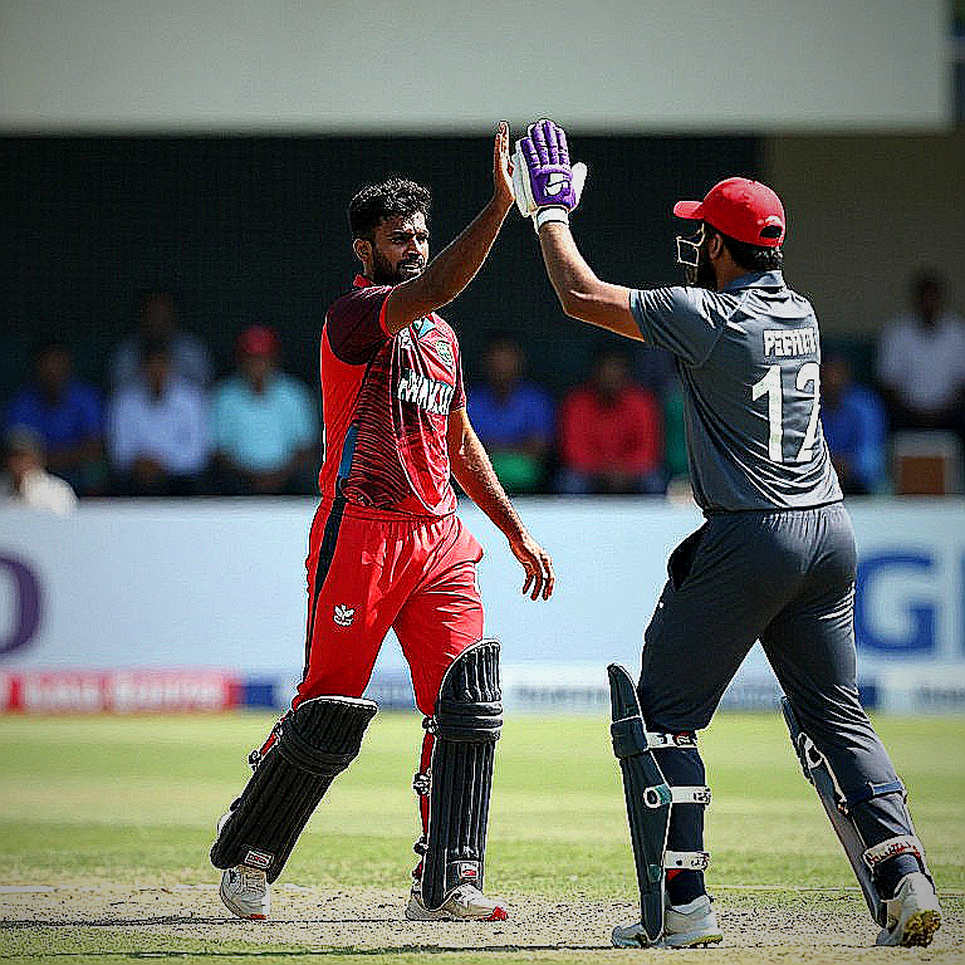
Pakistan's innings began in a way that made the target look distant. The team had lost two wickets with only 14 runs on the board. The second of those was the heaviest blow — Babar Azam departed without scoring. In a match where the chasing side needed 326 and where the top order had already collapsed, Babar's early dismissal was never going to relieve the pressure; it was only going to deepen it.
At that juncture Fakhar Zaman and Saad Baig steadied the innings. Saad Baig's knock is one of the least discussed and most important innings of this match: 74 runs, his first international half-century, and that too on the eve of his twentieth birthday, with only hours left in his nineteenth year. A fifty played in the final hours of being nineteen, one that took the team to a point from which winning became a realistic conversation.
Fakhar's century — and three lives
Fakhar Zaman made 127, the biggest individual contribution of the match. But honesty demands acknowledging that this was not a flawless innings. Fakhar was reprieved three times — on 6, on 69, and on 106. The third of those was the costliest, because his century was not yet complete at that point. Two chances connected to Maheesh Theekshana went to ground, and the consequence was that Fakhar accelerated thereafter and gave the innings a solid platform.
This matters because the one-line version — Fakhar's century beat Sri Lanka — would be only half the truth. Fakhar laid the foundation; others built on it.
After Fakhar: the Minhas-Nawaz stand of 94
Once Fakhar departed, Pakistan needed another partnership, and it came between Minhas and Mohammad Nawaz. The pair added 94 runs and made a difficult chase considerably simpler. This is the link that is most often skipped over, even though it did the thing every chasing side needs most: it kept the run rate moving while protecting wickets.
But calling it a 'match-winning' stand would also be an overstatement. With Pakistan needing just two more runs, Minhas fell, and Faheem followed him back to the pavilion almost immediately. The partnership that had made the match look easy expired, and the match slid back to the edge. In the end Shaheen Afridi had to walk out and finish it with a hit over the boundary.
That detail matters. It means the 94-run stand did not protect the finish — it only shortened the road. The match stayed alive until the final deliveries, and closing it out required courage from the lower order.
Shaheen and Rauf: where are the bowling numbers?
Shaheen Afridi's contribution came with both bat and ball. First he removed Kamindu Mendis and Dasun Shanaka, checking Sri Lanka's momentum, and then he delivered the final blow with the bat. Haris Rauf took two late wickets, and his method was clear — short deliveries, aimed at breaking the batsman's rhythm.
But one thing is worth noting: this report gives batting numbers in fine detail — 127, 74 off 61 balls, 131, 77, partnerships of 87 and 146, a fifty off 52 balls, a hundred off 84 — while bowling figures are almost absent. We are told Shaheen changed the game, but not his economy rate, his overs or a complete wicket tally. Minhas's left-arm spin is described as 'expensive', but how expensive is never stated.
That imbalance creates a problem for the reader: there is no way to judge independently which spell created the real pressure. There is exactly one hard data point — Sri Lanka lost six wickets in the last nine overs — and it is the only brick supporting the entire bowling-comeback narrative.
Sri Lanka's innings: Kamindu 131, Pavan 77
Sri Lanka's innings began superbly. Kamindu Mendis made 131 — his highest ODI score and more than double his previous career best. Pavan Rathnayake made 77, and the two shared a stand of 87. At one point Sri Lanka were 255 for two after 41 overs, with every possibility of a total well above 325.
But in the final nine overs Sri Lanka lost six wickets and collapsed to 325 for 8. The clearest reading of that slide is that the middle and lower order never found any late momentum. For Pakistan, no news could have been better — the target had, in effect, shed twenty or thirty runs in the last ten overs.
Rathnayake's number and its limits
Rathnayake is credited with 427 runs at an average of 106.75 in this tournament, along with a mention of a 'healthy strike rate'. At first glance the figure looks enormous. The arithmetic tells a slightly different story: 427 runs at 106.75 means the batsman was dismissed only four times. An average built on four innings carries no statistical meaning — it is a small and unstable sample. It can be treated as a hint about the future, not a conclusion.
Similarly, when every other figure in the same paragraph is precise, a phrase like 'healthy strike rate' should not require the reader to take anything on trust. The number should be there.
Pakistan's old wound: 14 for 2
Another worrying element for Pakistan was the start of the innings. Two wickets down with 14 on the board means the top order once again failed to do what was expected of it. Maaz first, Babar second — that sequence is a bad sign for any side.
And in that context, one fact never gets resolved: four days earlier this same team had been bowled out for 110, and here it chased 326. No explanation was ever offered for a swing of that size in the batting. The contradiction was used as a rhetorical flourish and never asked as a question.
Shared credit, one name
Look at the full ledger and the causes of this win are distributed across four or five contributors: Fakhar's 127, Saad Baig's 74, the Minhas-Nawaz stand of 94, Shaheen's two key wickets plus the winning hit, and Haris Rauf's two late wickets. Naming any one of them the owner of the victory is the easy route, and it leaves the reader with the false impression that a match was won on one man's back.
The arithmetic of the chase
There came a point when Pakistan needed 46 from 30 balls. That is hard but not impossible, particularly with set batsmen at the crease. Then came an over that yielded 15, and the equation cleared itself up. But the overs after that are nowhere recorded, which means the most dramatic final twenty deliveries of this match can never be replayed by a reader. That is a significant reporting gap: the material needed to justify calling it a thrilling finish is missing at precisely the place it matters most.
Seeing Sri Lanka as an obstacle
It is also worth noticing the framing. Throughout, the camera stays on one side — Pakistan's. Kamindu Mendis's 131, the highest score of his career, is presented as an innings in vain. A total of 325 for 8 is analysed as though it were background music for Shanaka's entrance. A side that was 255 for two after 41 overs and then threw its own match away receives no separate analysis of that collapse.
There is no factual distortion here — the numbers are accurate. The problem is perspective. When a team is treated as an obstacle for an entire match, its own significance quietly disappears.
The silence around this match
One thing about this match is genuinely strange: there is not a single direct quote from any player, captain or coach. After a match featuring a chase of 326, a first half-century by a young batsman on the eve of his twentieth birthday, three dropped catches and a finish that went to the last wickets — not one sentence from anyone involved. That silence suggests what has been written is not a first-hand account from someone at the ground but a scorecard plus an agency feed. No fact changes because of it, but the heat of the match never makes it onto the page.
What exactly was the tournament?
The biggest structural gap is that this match is described as part of a tri-series, yet the third team is never clearly named. The reader has to infer from scattered data points that the third side is England. This is basic reporting failure — the schedule, the points table, how many matches were played, whether Pakistan lost any of them, none of it is present. Without that, it is hard to judge how much this win is worth. Likewise, the player of the match and the player of the series — two routine but essential details — are entirely absent. Who won the toss, who chose to bat, whether Sri Lanka were bowled out or finished 325 for 8: none of it is stated.
Facts that decay with time
One more thing the reader should keep in mind — some of this information is only true on the day. Saad Baig's age is given as 'hours before his twentieth birthday', there is a reference to a match four days earlier, and a reference to Kamindu's debut seven years ago. The first two lose their meaning with time. If this report enters any reference collection, the date of publication must be attached to it, otherwise it will mislead anyone reading it later.
Conclusion: a real win, an incomplete story
As cricket, this is a hard-earned Pakistan victory. Chasing 326 from 14 for 2 is a pressure assignment for any side, and Pakistan did it — even if they held their breath until the final deliveries. Fakhar's century was the base, Saad Baig's 74 the turning point, the Minhas-Nawaz stand the bridge, and the Shaheen-Rauf bowling the wall.
But the picture of this match that has been built around a single name is an incomplete picture. Because the hero in whose name the win is recorded was dropped three times in the same match; and of the people who actually made the win possible, not one name reached the headline. A truthful match report tells you how a win was built — not who 'gave' it.